The Unspoken Luxury: Inside the Rise of the Silent Salon Appointment

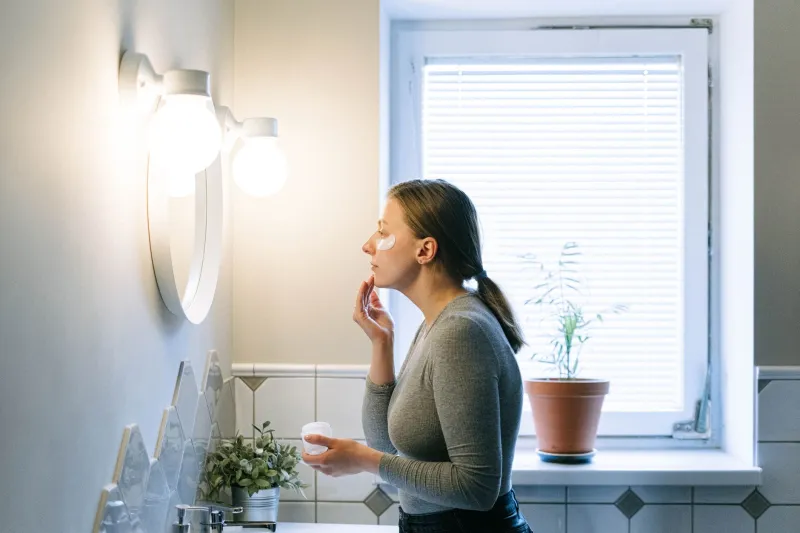
Photo: serene woman eyes closed facial treatment quiet spa salon minimal interior, via stacyling.com
There is a sentence appearing with increasing frequency in the notes field of British salon booking systems: quiet appointment, please. It is not a complaint, nor a special request in any medical sense. It is a preference, stated plainly, and it has quietly become one of the more interesting developments in the UK's treatment economy.
For an industry built on conversation, that is a notable shift. The blow-dry bar and the facial room have long traded on sociability, on the ritual of being known, on the stylist who remembers the wedding and the holiday and the difficult sister. What the silent appointment proposes is the reverse: attention without interrogation, care without commentary. The appeal, once considered, is not difficult to understand.
How silence became a service
The change has been gradual and, for the most part, unannounced. Salon owners in London, Manchester and Edinburgh report that requests for minimal conversation have moved from the occasional aside to a routine instruction, particularly in December and in the days surrounding major social occasions. Some have formalised it, offering designated quiet slots or a quiet chair at certain times of day; others simply train staff to read the booking note and to work accordingly.
The logic is not purely therapeutic. A client who is not being talked to is a client who is not being sold to, and the quiet appointment has arrived alongside a broader fatigue with the running commentary of upselling. There is also a practical dimension: a stylist who is not performing small talk is a stylist working with greater concentration, and the finished blow-dry is often the better for it.
What the silence is actually buying
It would be easy, and slightly patronising, to frame this as a retreat from technology or a symptom of post-pandemic social exhaustion. The truth is more considered. Readers who spend their working days in meetings, on calls and in the relentless performance of availability are not necessarily depleted by conversation as such; they are depleted by conversation that has no purpose beyond itself.
A salon appointment, by contrast, has a clear purpose. The client arrives with an outcome in mind, and the hour in the chair is one of the few in the diary where nothing is expected of them beyond sitting still. Buying silence, in this reading, is buying an hour of undivided attention in both directions. The treatment is the point, and the absence of chatter protects it.
There is a vanity argument, too, which the industry is understandably reluctant to make aloud. For the image-conscious, a facial or a blow-dry is at least partly a matter of preparation, and preparation benefits from focus. The client who spends forty minutes discussing the weather has spent forty minutes not relaxing; the jaw stays set, the forehead stays busy, and the treatment does less than it might. Silence is, in a small way, a technique.
The etiquette of asking
The request should be made at the point of booking rather than on arrival. A note attached to the appointment gives the salon time to allocate the right member of staff and the right slot, and it spares both parties the mild awkwardness of a negotiation in the reception area.
It is also worth being specific. Total silence is rarely what is meant. Most clients want a thorough consultation at the start, a brief word at the finish, and nothing in between; saying so removes the ambiguity and prevents a stylist from interpreting quietness as displeasure. Those who find eye contact difficult to manage during a treatment often bring headphones, though it is courteous to check that this is acceptable beforehand.
There should be no expectation of a discount, and none of a reduced tip. Quietness is a style of service, not an absence of it, and the practitioner is still performing the same work with the same skill.
The counter-argument, fairly stated
Not everyone welcomes the trend. Long-standing clients value continuity, and continuity is built on conversation; a salon that becomes too reverent risks feeling clinical. A good stylist often learns more about a client's hair from unguarded talk than from any consultation form, and there is a real pleasure, particularly for older clients living alone, in the sociability of the weekly appointment.
The sensible position is that both should coexist, and in the better salons they already do. The quiet slot is an option, not a policy, and a service industry that can read a room well enough to offer both is simply doing its job properly.
Our view
The silent appointment is not a rejection of warmth. It is a refinement of it: a recognition that hospitality can be expressed through attentiveness rather than talk, and that the most polished service is the one that asks very little of the person receiving it. In a season of compulsory cheerfulness, an hour in which nothing is required but stillness may be the most luxurious thing on the calendar. Book it, say little, and leave with the particular calm of someone who has been looked after without being asked a single question.